Tight foreskin problem: the 2 types of phimosis (physiological and pathological)

In this article, we will talk about a specific tight foreskin problem called phimosis.
Before going into detail of what is a phimosis and how to treat it, we’ll see what is the human foreskin (also called prepuce) and why its functions are so important.
What is the foreskin
The foreskin is a fold of skin that covers the glans (or head) of the penis. It is present at birth. The main function of the foreskin is to protect the sensitive glans, keeping it moist and aiding in sexual function.
The foreskin usually becomes retractable after childhood. In fact, during puberty, foreskin retractability gradually increases along with sexual maturity, allowing the glans to be more exposed when needed. By the end of puberty, most males have a fully retractable foreskin.
On the other hand, however, some men may experience a condition where the foreskin is still not completely retractable even after puberty. Some studies discovered that this condition affects the 1% of world population. This tight foreskin problem is called phimosis.
The phimosis
As we said, phimosis is a condition in which the foreskin is tight and difficult (or even impossible) to retract over the head of the penis. Although this can be a simple developmental stage in young males that resolves on its own, chances are that if the tight foreskin problem persists after childhood it may cause discomfort, difficulty with hygiene and many other complications such as infections.
Other symptoms of a phimosis include:
- Redness or discoloration of the glans;
- Swelling;
- Soreness;
- Pain with erections or with sexual activity.
What causes phimosis?
There are various reasons why a phimosis might develop. These include:
- Skin conditions such as eczema and psioriasis;
- Poor hygiene can be both a cause and a result of phimosis;
- Prepuzial adhesions (or scar tissue) that keep the foreskin attached to the head of the penis;
- Infections, including the sexual transmittable ones (STIs).
The two different types of phimosis
There are two different types of phimosis, the physiological and the pathological:
- Physiological phimosis is the normal condition in which the foreskin is tight in early childhood and then gradually becomes more retractable with age. It is common to have a non-retractable skin during childhood, and in this case the tight foreskin problem resolves on its own.
- Pathological phimosis, also called secondary phimosis, occurs when the foreskin remains tight and non-retractable beyond childhood, leading to potential issues, such as pain, difficulty urinating, or hygiene issues.
In case of a pathological phimosis, a medical intervention may be necessary. These interventions include stretching exercises, topical steroid creams, or surgical interventions such as circumcision or a dorsal slit.
Tight foreskin problem treatment
Now let’s take a deeper look at how the tight foreskin problem is treated.
While physiological phimosis usually doesn’t need treatment, the pathological phimosis does need to be treated. The possible treatments include:
- The aforementioned steroid cream, which must be applied on the penis’ skin.
- The stretching exercises should start after about two weeks of applying the steroid cream. The skin mus be stretched very gently, pulling it back only as far as possible without feeling pain.
- Another possible treatment is surgery. The most common type of interventions to resolve phimosis is circumcision. This procedure removes the foreskin and frees the glans.
Complications related to circumcision and recovery times
As we said, circumcision is the most common procedure for tight foreskin problems treatments. However, the intervention can lead to specific risks and complications. These include pain, bleeding and/or infections. The recovery times from a circumcision operation are usually around 7-10 days.
Phimosis and paraphimosis
There are other conditions that can affect the foreskin, and it’s easy to mistake them from one another. So, what are the difference between phimosis and paraphimosis?
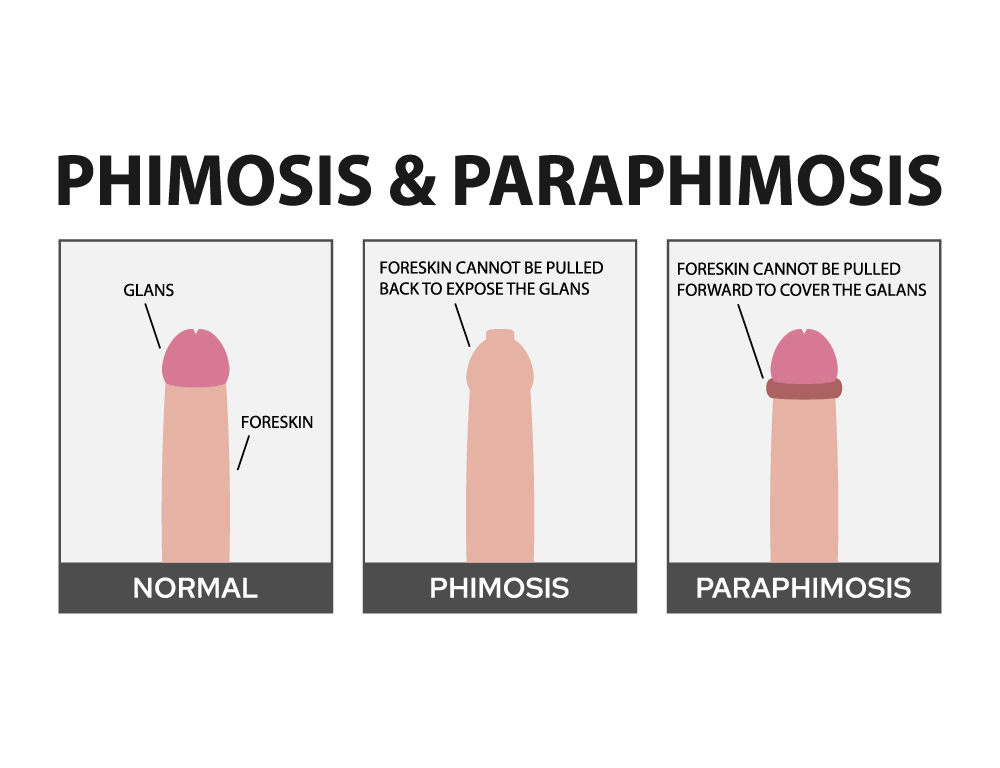 They are both conditions that affect the foreskin. However, while phimosis isn’t always an emergency, paraphimosis is.
Paraphimosis affects men who are partially or completely uncircumcised. The foreskin gets stuck behind the corona of the penis and can’t be moved back towards the tip. It can happen while doing stretching exercises and the foreskin seems unable to get back in place. The treatment is required so that the tip of the penis isn’t damaged to the point of developing gangrene.
Other tight foreskin problems
Other than physiological phimosis and pathological phimosis, there are other conditions that affect the human foreskin, such as:
- Buried penis: this one usually affects newborns or obese prepubertal boys, but it can also more rarely affect adults. It is a congenital disorder in which a penis of normal size lacks the proper sheath of skin and lies hidden beneath the integument of the abdomen, the thigh or the scrotum.
- Micropenis (or microphallus) is when the penis is less than 2 standard deviations below the mean in length when measured while stretched.
- Diminutive penis is a penis that is small, malformed, affected by epispadias, exstrophy, severe hypospadias, chromosomal abnormalities.
- Trapped penis is when the penis becomes inconspicuous due to a cicatricial scar, usually after a circumcision.
- Webbed penis is an obscuration of the penile shaft by scrotal skin webs at the penoscrotal junction.
Phimosis and hygiene
Preserving a good hygiene is fundamental to maintain genital health. And with phimosis proper hygiene becomes even more crucial, because if the foreskin is not adequately cleaned, it can lead to hygiene-related issues and potential complications, such as infections.
Some fundamental rules of genital hygiene include:
- Use non-irritating soap and warm water to clean the genital area. Gently retract the foreskin if possible without forcing.
- Avoid harsh products, like harsh soaps, antiseptics or performed products. They can cause irritation to the genital area.
- Soaking in a warm bath can help soften the foreskin, making it easier to retract.
- Establish a daily regular cleaning routine to prevent the buildup of Smegma (substance made of dead skin cells and other bodily fluids)
Seeking medical guidance is important for a person affected by phimosis who’s struggling to maintain proper hygiene. A healthcare professional can provide guidance on safe and effective cleaning practices and recommend appropriate treatment options.
Do you need help? Contact us and speak with a private consultant.

